
On AI: The Human Bridge to AI Performance: Why AI Leadership Will Determine Who Wins

Updated: May 19

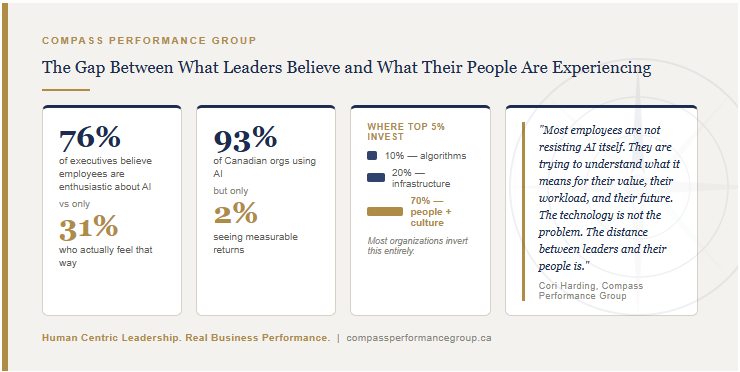
93% of Canadian organizations are now using AI.
Only 2% are seeing measurable returns.
After reading the research, one thing became very clear to me: This is no longer primarily a technology conversation. It is a leadership conversation. The organizations seeing results are approaching AI differently. They are investing not only in tools, but in leadership capability, workforce adaptation, and the very human side of transformation.
I believe this may become one of the greatest leadership opportunities of our generation.
The Human Bridge to AI Performance
Most organizations are no longer struggling with access to AI tools themselves. They are navigating something far more human: adoption, trust, capability, and the realities people experience when the nature of work begins to shift beneath them.
This disparity is often framed as a technical failure, but it is actually one of the most significant leadership opportunities in front of us. For organizations willing to pivot their focus, the gap between adoption and performance represents a very real competitive advantage.
The organizations seeing the greatest success with AI are not necessarily the ones with the largest technology budgets. They are the ones treating AI leadership as a core business capability and helping their people adapt to change effectively.
The Multiplier Effect of Engaged Leadership
Research suggests that organizations with leadership teams who are deeply and visibly engaged with AI are twelve times more likely to be top performers in AI innovation.
That level of engagement matters.
Leaders who experiment publicly, challenge assumptions, ask better questions, and model learning in real time create permission for others to do the same. Culture shifts faster when leaders visibly participate in the change rather than simply sponsor it from a distance.
The real multiplier is not simply the investment in technology itself, but the investment in the people expected to use it. KPMG research found that executives are twice as likely to invest in technology as they are in training and workforce capability, despite 57% of leaders identifying performance and efficiency as top priorities and fewer than 10% prioritizing leadership and workforce development.
Technology creates potential.
People determine whether that potential becomes performance.
A Strategic Opportunity for Canadian Business
Canada has a proud history of shaping much of the foundational research behind modern AI, yet we currently rank 44th out of 47 countries in AI literacy and training.
While that ranking should get our attention, it also highlights the scale of opportunity in front of us.
Organizations that move early on workforce capability, leadership development, and human adaptation will separate themselves quickly. The advantage will belong to the organizations that define the shift clearly for employees, equip managers to guide teams through uncertainty, and create environments where learning feels possible rather than threatening.
There is also a meaningful gap between what many senior leaders believe is happening on their teams and what employees are actually experiencing on the front lines of AI adoption. In many organizations, that disconnect is quietly slowing momentum.
The encouraging reality is that these are highly solvable leadership challenges.
Three Leadership Priorities Every Executive Team Should Focus on Right Now
Invest in workforce capability as aggressively as technology. AI adoption accelerates when employees feel equipped, supported, and confident in how the tools connect to their work.
Make leadership adoption visibility part of the AI strategy. Leaders who actively use AI themselves shape culture faster than any communication plan.
Clearly define the human impact of the shift. Employees need more than technical training. They need clarity around how work, value creation, decision-making, and leadership expectations are evolving.
AI has a unique way of exposing the gaps in our leadership models, but it is also the catalyst to close them.
The organizations that win in the AI era will not be the ones that automate the fastest.
They will be the ones that help their people adapt most effectively.
If this is resonating, send me a message. I would love to hear what this looks like inside your organization.
__________________________________________________________________________________
Sources
• KPMG in Canada (2025): Beyond AI Adoption: Turning Canada’s AI Momentum into Measurable Returns
• KPMG International & University of Melbourne (2025): Trust, Attitudes, and Use of Artificial Intelligence: A Global Study
• Boston Consulting Group (2025): The Widening AI Value Gap: Build for the Future Global Study
• KPMG Generative AI Adoption Index (2024/2025)


Comments